
1980 Penny Value Explained: One Detail Can Multiply Its Price
The United States Mint produced over twelve billion pennies in the year 1980 during a period of high economic activity.
Most people find these coins in their daily change without thinking about their potential financial value in the modern collector market.
Collectors evaluate these small copper coins based on their physical condition and the presence of specific manufacturing mistakes.
The copper price in a standard 1980 penny often exceeds the face value of one cent because the metal content weighs approximately 3.11 grams.
Understanding the technical 1980 penny value differences between a common coin and a rare specimen requires looking at specific numbers and auction records.
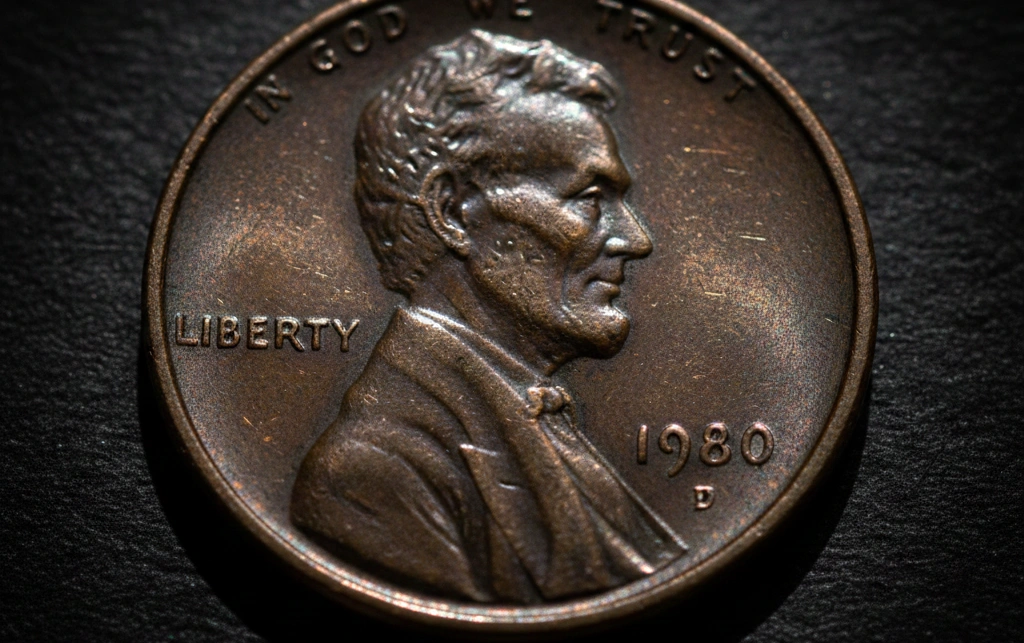
General Production Statistics for 1980
The 1980 Lincoln penny came from three different locations, including Philadelphia, Denver, and San Francisco.
Each mint facility produced a different quantity of coins, affecting the long-term availability of high-quality examples today.
Mint Location | Mint Mark | Production Quantity |
Philadelphia | None | 7,414,705,000 |
Denver | D | 5,140,098,660 |
San Francisco (Proof) | S | 3,554,806 |
The Philadelphia Mint created the largest number of units, resulting in a high supply of circulated coins for the general public.
Denver produced a significant amount of pennies marked with a small D located directly under the date on the front side.
San Francisco focused on proof coins intended for collectors rather than for general use in stores or banks.
Technical Specifications of the 1980 Penny
The physical composition of the 1980 penny consists of 95% copper and 5% zinc providing a reddish color to new coins.
The weight of 3.11 grams makes these coins heavier than the zinc pennies produced after the middle of 1982.
Feature | Specification |
Diameter | 19.05 mm |
Edge | Plain |
Composition | 95% Copper, 5% Zinc |
Weight | 3.11 grams |
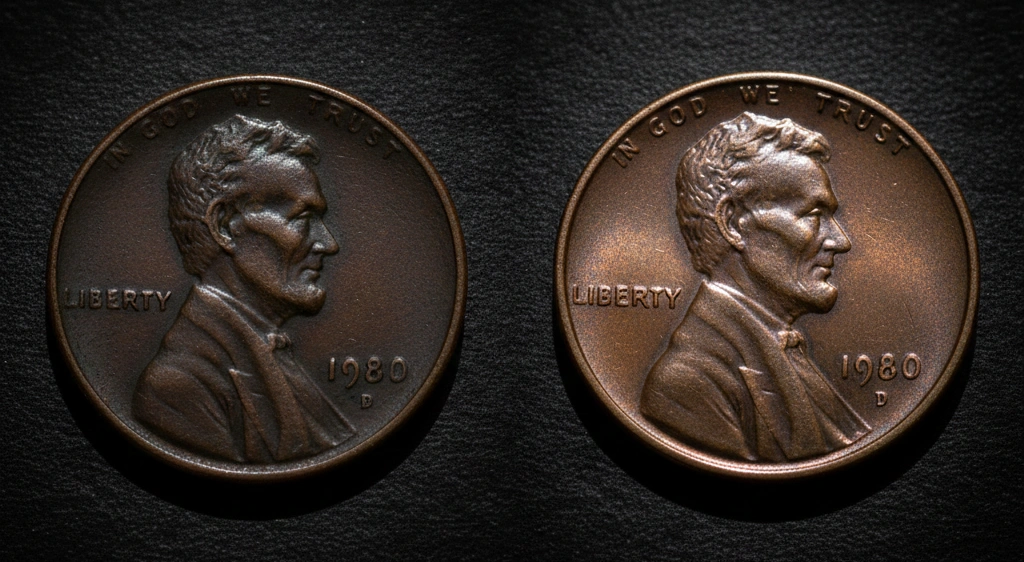
Maintaining the original red color increases the market price significantly compared to coins turning brown from air exposure.
Professional grading services use a scale from 1 to 70 to determine the exact state of preservation for every individual coin.
The One Detail: Doubled Die Errors
Finding a doubled die error on a 1980 penny multiplies the price from a few cents to hundreds of dollars.
A doubled die occurs during the hubbing process, creating a second set of images or letters on the coin surface.
Identifying this error involves looking at the words "IN GOD WE TRUST" and "LIBERTY" using a coin value checker app.
The doubling appears most clearly on the date and the letters located on the left side of Lincoln's portrait.
Market data shows a 1980 Philadelphia penny with a Doubled Die Obverse reaching prices between $100 and $300 in high grades.
Comparing the price of a standard penny to an error penny shows an increase of over 10,000% in many recorded sales.
Value Trends by Grade and Color
Coin values depend on the color classification, categorized as Brown (BN), Red-Brown (RB), or Red (RD).
Red coins represent the highest level of preservatio,n showing at least 95% of the original mint orange-red luster.
Grade (MS) | Brown Value | Red-Brown Value | Red Value |
MS 63 | $0.10 | $0.25 | $1.00 |
MS 65 | $1.00 | $2.00 | $15.00 |
MS 66 | $5.00 | $10.00 | $35.00 |
MS 67 | $20.00 | $45.00 | $150.00 |
Statistical analysis of auction data reveals that MS 67 Red pennies grew in value by approximately 5% annually over the last decade.
Lower-grade coins stay flat in price due to the massive supply available in old jars and bank rolls.
The transition from MS 67 to MS 68 creates a massive price jump because very few coins survive without tiny scratches.
Record Auction Prices for 1980 Pennies
High-end auctions provide evidence for the maximum potential value of perfectly preserved 1980 pennies.
A 1980 Philadelphia penny graded MS 68 Red sold for $2,232 in a 2017 public auction.
The Denver version of the 1980 penny in MS 68 Red condition reached a price of $546 during a Heritage Auctions event.
Proof coins from San Francisco usually sell for $5 to $10 in standard PR 69 condition due to high survival rates.
A perfect PR 70 Deep Cameo 1980-S penny can command prices near $200 depending on the current demand at auction.
These prices reflect a market paying a premium for coins sitting at the top of the grading scale.
Other Mint Errors Increasing Price
Beyond the doubled die, other manufacturing mistakes attract buyers willing to pay more than the face value.
Off-center strikes happen when the coin blank sits incorrectly in the press during the striking process.
A 1980 penny struck 10% off-center typically sells for $5 to $15, depending on the visibility of the date.
Pennies struck 50% off-center, showing the full 1980 date, can reach prices between $50 and $100 in uncirculated condition.
Die cracks appearing as raised lines of metal on the coin surface add a small premium of $1 to $5.
Major errors like a penny struck on a dime planchet create unique silver-colored coins worth over $500.
Grading Factors and Preservation Techniques
Preserving the copper surface requires keeping the coin in a cool and dry environment, avoiding direct contact with fingers.
Oils from human skin cause chemical reactions, leading to permanent brown spots on the copper metal.
A professional coin identifier app examines the fields of the coin for marks caused by other coins hitting it in bags.
The strike quality determines the sharpness of the hair on Lincoln's head and the lines on the Lincoln Memorial.
A weak strike reduces the grade even if the coin has no scratches or visible wear from circulation.
Standard 1980 pennies found in circulation usually grade between Very Fine and Extremely Fine, having a value of only one cent.
Comparing 1980 to Other 1980s Pennies
The 1980 penny remains a pure copper alloy coin, unlike the 1982 and 1983 versions consisting mostly of zinc.
Investors buy 1980 pennies in bulk for their copper weight, realizing a 150% profit over face value at current metal prices.
The 1983 penny has a much higher potential for expensive doubled die errors compared to the 1980 production year.
Historical price data shows the 1980 penny maintaining a steady position in the market without the volatility seen in newer coins.
Year | Metal Content | Weight | Standard Value (MS 65) |
1980 | Copper | 3.11g | $15.00 |
1981 | Copper | 3.11g | $12.00 |
1982 | Mixed | 3.11g/2.5g | $10.00 |
1983 | Zinc | 2.50g | $5.00 |
The copper shortage of the early 1980s led to the change in composition, making the 1980 penny one of the last heavy cents.