
Why Most Nickels Stay Ordinary — and a Few Become Valuable
The difference lies in details most people overlook.
Mass production of five-cent coins in the United States results in billions of units entering circulation annually.
Most of these nickels worth money retain only face value throughout their entire functional life.
Collector value emerges following disruptions in standard manufacturing protocols at mint facilities.
Parameter | Official Value |
Mass | 5.000 grams |
Diameter | 21.21 mm |
Thickness | 1.95 mm |
Composition | 75% Copper, 25% Nickel |
Edge | Plain |
Shape | Round |
Using a copper-nickel alloy provides high durability for the surface.
Material hardness complicates achieving full image detail during low-pressure striking cycles.
Detail Impact on Market Pricing: The Full Steps Factor
The quality of the steps on the Monticello building remains the central element for evaluating Jefferson coins.
Defining the Full Steps (FS) designation requires five or six clearly separated horizontal lines.
Lack of contact between these steps indicates a weak strike or die exhaustion.
Price Variation Based on Full Steps (FS) Grading:
2013-D MS67 without FS: $15 → 2013-D MS67 with FS: $3,200
1994-P MS67 without FS: $10 → 1994-P MS67 with FS: $1,150
1963-D MS65 without FS: $5 → 1963-D MS65 with FS: $4,500
Annual value growth for specimens showing full steps reached 8.4% during the 2021–2026 period.
Increased investor interest in strike quality stems from the rarity of high-detail coins found in standard metal alloys.
Die Defects Creating Rarity
Mechanical damage occurring during die operation produces repeating anomalies.
A cracked die leaves a raised line of metal on the coin blank.
Valuable Defect Classification:
Double Die Obverse (DDO) — doubled design elements on the front side.
Repunched Mint Mark (RPM) — multiple applications of the mint letter.
Die Clash — impact between dies without a metal blank present.
Die Crack — deep fractures running through primary design areas.
Placement of a defect on critical portrait details increases the price premium.
Cause → Effect in production:
Grease on the die → Lack of detail in the final image → Value dropping to face value.
Severe die collision → Transfer of reverse outlines to the obverse side → Value increasing 400% over standard coins.
Historical Sales and Investment Data
Analysis of completed transactions at Heritage and Stack’s Bowers auctions confirms segment stability.
Rarity depends on the survival of coins in "as-minted" condition.
1913 Liberty Head Nickel: $4,560,000 (2018 record)
1918/7-D Buffalo Nickel (DDO): $350,750
1926-S Buffalo Nickel MS66: $322,000
1942-D D/D Jefferson Nickel (MS64): $32,900
Market cap changes for rare nickels over the last 10 years:
2016: $100,000 → 2026: $168,000 (68% total growth).
Liquidity drops significantly when signs of corrosion or cleaning appear.
Chemical removal of surface patina reduces final appraisal by 60–75%.
Wartime Silver Series (1942–1945)
Modification of the metal alloy during World War II resulted from the need to divert industrial metals to defense production.
Replacing standard nickel with silver and manganese changed the physical properties of the coins.
Wartime Alloy Composition:
Silver: 35%
Copper: 56%
Manganese: 9%
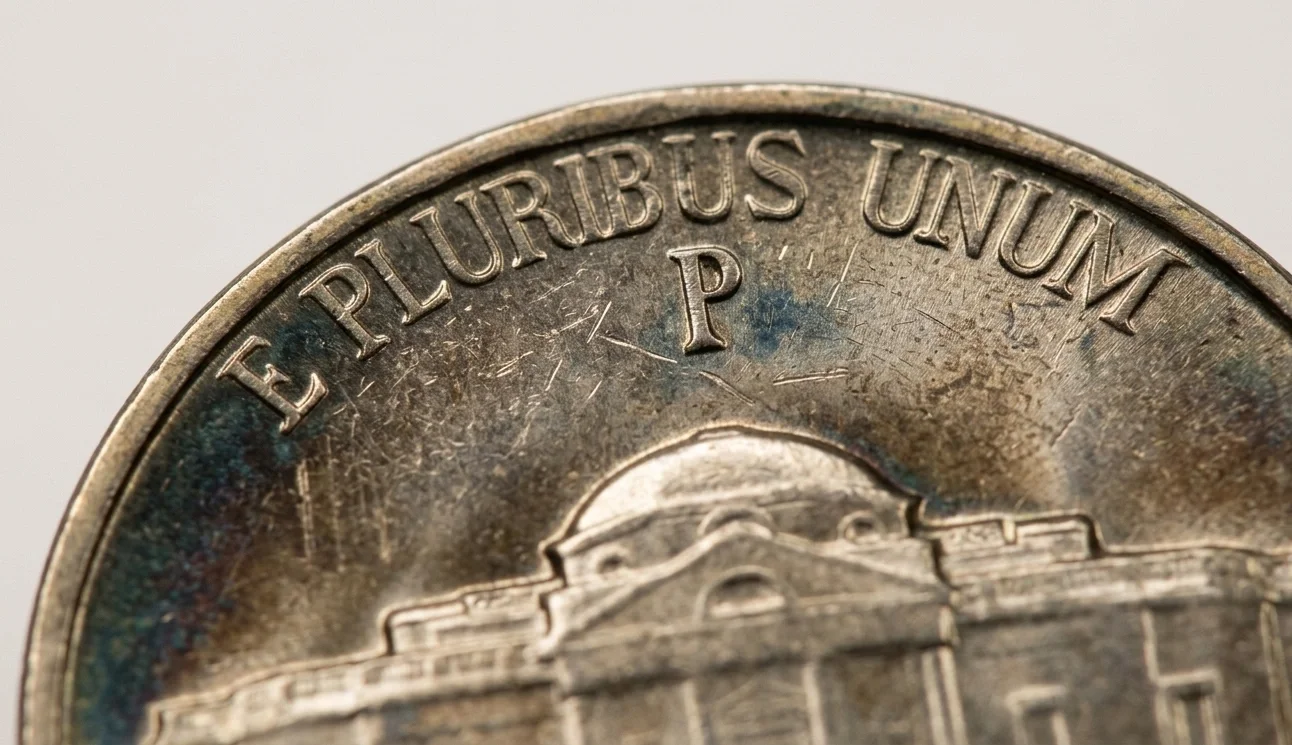
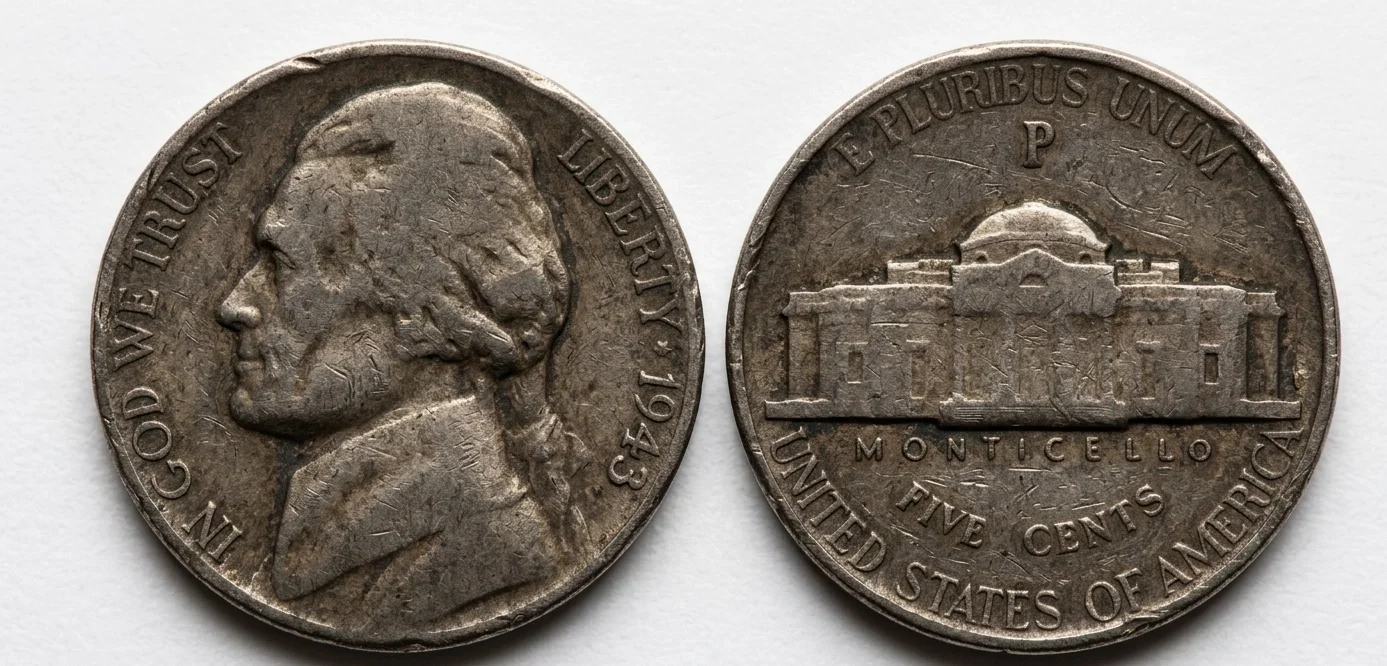
A large mint mark placed above the Monticello dome serves as the primary identifier for this series.
Silver nickels possess a characteristic dull luster and a tendency to develop dark surface toning.
Year and Mint | MS66 Grade | MS67 Grade |
1942-P | $145 | $650 |
1943-D | $120 | $580 |
1944-S | $160 | $950 |
1945-S | $135 | $720 |
Presence of vivid rainbow toning adds between 20% and 150% to the lot price.
Investors view these coins as hybrid assets combining historical value with precious metal content.
Blank Errors and Feeding Failures
The process of punching metal circles from strips allows for geometric inconsistencies.
A defective blank entering the striking zone creates unique collectible objects.
Blank Error Analysis:
Off-Center — the metal blank failing to seat correctly under the die.
Clipped Planchet — using the edge of the metal sheet during punching.
Wrong Planchet — striking a 5-cent design on 1-cent or 10-cent blanks.
Image displacement exceeding 50% while showing a clear date → Price $450.
Strike on a copper cent blank → Price $1,200.
2026 error detection statistics per 1,000,000 coins:
Off-center > 10%: 12 units → Double strike: 3 units → Wrong blank: 0.1 units.
Professional Certification Systems
Verifying authenticity and condition requires independent labs like PCGS or NGC.
Using plastic holders protects the metal from oxidation and mechanical scratches.
Sheldon Scale Grading Criteria:
MS70 — a perfect specimen showing no flaws at the best coin appraisal app.
MS65 — minor marks not affecting primary design details.
AU58 — minimal wear appearing on the highest points of the relief.
XF40 — moderate wear retaining clarity in all lettering.
Price differences between MS66 and MS67 grades often exceed the coin's base value tenfold.
Professional certification remains a mandatory requirement for transactions exceeding $500.
Absence of a certificate reduces buyer confidence, lowering the final price by 30%.
Buffalo Type Nickels (1913–1938)
The James Earle Fraser design remains one of the most difficult to strike with high detail.
Rapid wear of the date on the Native American portrait represents the primary technical issue for this series.
Key Dates and Market Performance:
1921-S: High rarity in grades above VF.
1913-D Type 2: First year featuring the modified reverse design.
1937-D "3-Legged": Resulting from excessive die polishing removing one leg of the bison.
The 1937-D 3-Legged in EF45 condition sells for $850.
The same specimen in MS65 condition reaches $25,000.
Demand dynamics for Buffalo Nickels over the last 5 years:
2021: Stable → 2023: 15% growth → 2026: Peak interest in high-grade coins.
Logic of Mintage Rarities
Limited production at specific mint locations creates artificial scarcity.
The San Francisco Mint (letter S) traditionally produces lower volumes compared to Philadelphia (P) or Denver (D).
Mint Facility | Mintage (Millions) | Price in MS65 |
Philadelphia | 9.8 | $45 |
Denver | 2.6 | $120 |
Low mintage made the 1950-D one of the most sought-after coins in the mid-20th century.
Massive hoarding of these coins by collectors led to an oversupply in Mint State condition.
Result → High nominal rarity paired with moderate market price.
Overdate Errors and Die Chronology
Using old dies while applying a new date over the previous one created unique number combinations.
Die manufacturing technology used before the 1990s allowed such anomalies.
1943/2-P Jefferson Nickel: a famous wartime error.
1918/7-D Buffalo Nickel: a classic early-century overdate.
The 1943/2-P in MS65 condition reaches $4,200.
Discovering such coins in general circulation in 2026 is technically impossible.
All known specimens remain distributed among private and museum funds.
Methodology for Independent Searching
Finding a rare coin requires a systematic approach to examining cash.
Using a macro lens, a coin appraisal app free, and side lighting helps reveal micro-defects.
Initial Verification Algorithm:
Identify the year and mint mark.
Visually inspect the Monticello steps on the reverse.
Search for doubling on "LIBERTY" and "IN GOD WE TRUST" lettering.
Check the edge for a copper layer (indicating a strike on a cent blank).
Lack of wear on Jefferson’s hair indicates high preservation.
Presence of six distinct steps separates a coin from 99% of the general population.
Consulting "Cherrypickers' Guide" catalogs assists in identifying rare varieties.